Three major international tech events and multiple industrial cooperation deals took place within just one week. WWDC brought sweeping upgrades to AI underlying architectures. PCIM pushed forward iterative progress in power semiconductor technologies. Sensors Converge delivered advances in edge intelligence. A technology wave covering chips, systems and end devices is gathering momentum at a faster pace.
The semiconductor industry has seen remarkable momentum over the past week. The Semiconductor Industry Association (SIA) endorsed the Spring 2026 forecast released by WSTS. Global semiconductor sales are projected to rise 90% for the full year and exceed 1.5 trillion US dollars. The figure is expected to top 1.9 trillion US dollars in 2027. This outlook marks a notable upgrade. Less than six months ago, most industry insiders estimated the market would only surpass the 1 trillion US dollar mark in 2026.
The upward revision of market forecasts traces back to one core driver which is artificial intelligence.
The latest data from SEMI also confirms this trend. Global semiconductor equipment shipments reached 36.55 billion US dollars in the first quarter of 2026, up 14% year on year and hitting a new quarterly high. SEMI stated clearly that robust investment related to artificial intelligence led this growth. Such investment supports capacity expansion and technical upgrades for advanced logic chips, DRAM products and advanced packaging solutions. The entire industrial chain from upstream equipment to downstream chip applications is stepping up to meet the strong demand for computing power in the AI era.
Industrial cycles are never shaped by technology alone. Geopolitics, supply chain restructuring and competition over national industrial policies are reshaping the global semiconductor landscape. A string of recent events shows how these factors influence the direction of the sector from multiple perspectives.

Tim Cook stepped onto the WWDC stage as Apple CEO for the final time in the early hours of June 9 Beijing time. This event is regarded as a pivotal transition for the company. Its biggest highlights lie in underlying technical adjustments rather than visible interface changes for users.
According to available information, Apple is upgrading CoreML into the brand new CoreAI framework. It also launched Extensions, a set of developer tools. The new tools enable third party AI models to run deep within system layers. This move represents a shift from Apple's traditionally closed ecosystem. Siri will no longer only run Apple's proprietary AI models. It is set to become a system level AI hub that connects mainstream large language models including Gemini, ChatGPT and Claude.
iOS 27 draws comparisons to Mac OS X Snow Leopard in update positioning. It focuses on bug fixes, performance optimization and stability improvement instead of adding numerous new functions. These subtle underlying adjustments will exert a far reaching influence on Apple's ecosystem over the next three to five years more than flashy AI applications. One analyst commented that Apple's capability to maintain its ecosystem as a leading computing platform will be proven through these invisible technical changes.
Apple's upgrade of AI underlying frameworks is not an isolated technical move. It responds to a major industrial shift. AI services are gradually moving from the cloud to end devices. Companies that integrate AI capabilities seamlessly at the system level will gain an edge in end device competition over the next five years.

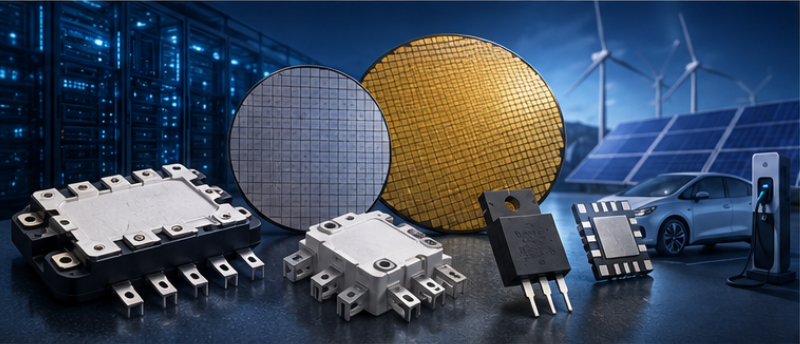
PCIM Europe 2026 kicked off in Nuremberg, Germany, showcasing intense technical competition in power semiconductors. Infineon unveiled comprehensive silicon, SiC and GaN power solutions that cover full-link power management from grid access to processor cores. AI data centers have become the core growth driver for power semiconductor vendors. Skyrocketing AI computing workloads are pushing data centers to replace traditional centralized power systems with high-voltage DC distribution and DC microgrids, requiring power supply units, voltage regulator modules and other core components to meet higher standards for power density, efficiency and reliability.
ROHM demonstrated its independent GaN development roadmap at the event. The company will introduce AIXTRON's G10 GaN deposition system to build 8-inch GaN epitaxial wafer mass production capacity at its Japanese Hamamatsu plant. Its 650V and 100V GaN devices target AI data center power supplies and electric vehicle main drive systems, covering server power supply, on-board charging and GPU voltage regulation scenarios with strong market demand. A Renesas executive predicted the GaN industry will hit a large-scale commercialization turning point next year, with 2028 becoming a key industrial development year. The firm plans to expand its production capacity eightfold to meet surging market orders.
Such material competition reflects major structural shifts in the power semiconductor industry. GaN and SiC devices are rapidly phasing out conventional silicon MOSFETs in mid-to-low and mid-to-high voltage scenarios. Driven by the infrastructure upgrade of AI computing centers, AI is fueling robust demand for not only computing chips, but also the entire power supply system.
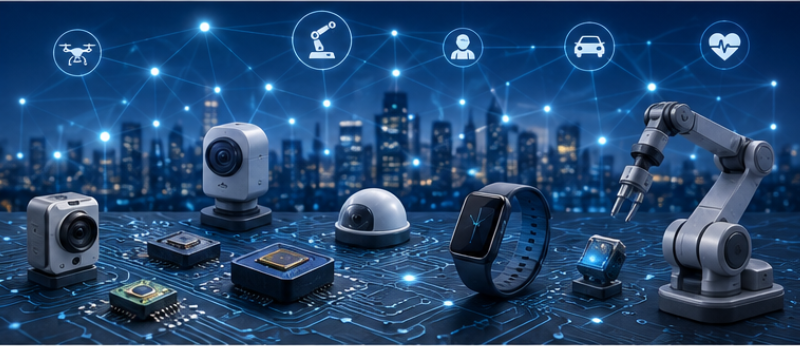
Sensors Converge 2026 took place in Santa Clara, United States from June 8 to June 10. The summit attracted nearly 5000 attendees and more than 160 exhibitors. Its core theme centers on the expansion of intelligent capabilities for sensors as related functions shift from cloud platforms to end devices.
A quote from Pankaj Kedia's keynote speech was widely circulated. AI cannot operate without data input and output and sensors handle both tasks. On site technical demonstrations turned this abstract idea into practical examples. Pete Bernard from EDGE AI FOUNDATION compared the current stage of edge AI to the steam engine era. Collaborative model training and node based learning are developing rapidly without relying on cloud connections.
The trend comes down to practical benefits. Running AI inference locally on sensors instead of in the cloud effectively reduces latency, enhances data privacy and cuts energy consumption for data transmission. Such progress relies on advanced underlying chips including miniaturized MEMS sensors, low power edge AI chips and high efficiency embedded processors. According to Mordor Intelligence, the global MEMS sensor market will grow from 20.24 billion US dollars in 2026 to 29.08 billion US dollars in 2031. Large scale deployment of edge AI and miniaturization of wearable devices serve as the major growth drivers.
This trend further validates the rise of end side AI. WWDC showcased AI integration at the operating system level while Sensors Converge focuses on hardware upgrades at the fundamental layer. AI technology is being embedded into every sensor node to equip end devices with powerful perception capabilities.
The GSA European Executive Forum was held in Munich. Executives from Europe's semiconductor industry discussed a pressing issue beyond technical research. They explored how Europe can build solid industrial resilience while maintaining global cooperation amid geopolitical pressures.
Europe has formed a clear development strategy. It does not pursue full self sufficiency across the entire industrial chain. Instead, it aims to establish irreplaceable advantages in key links. ASML's EUV lithography systems are essential for advanced chip manufacturing. IMEC in Belgium stands as a core hub for research on advanced process technologies. IDM manufacturers including Infineon and STMicroelectronics maintain strong expertise in automotive and industrial semiconductors.
Analysts point out that Europe is striving to strike a balance between risk mitigation and decoupling. It avoids over reliance on external partners while retaining the efficiency of global industrial division of labor. This model differs from the capacity focused strategies of Taiwan region and South Korea as well as the industrial reshoring policies of the United States. Europe's semiconductor sector will rely more on long term strategies that combine geopolitical positioning, industrial strengths and policy frameworks.
An AMD executive delivered remarks at London Tech Week that echo supply chain concerns. Capacity constraints for AI chips are no longer limited to advanced manufacturing processes. Advanced packaging technologies have also become major bottlenecks. The evolution of packaging solutions ranging from CoWoS to Chiplet reshapes chip design concepts and industrial division of labor. It indicates that semiconductor competition in the AI era is no longer a contest of single technologies or individual links. It has evolved into a comprehensive competition across the whole industrial chain.

Beyond industrial events, a new research achievement released by MIT on June 8 draws wide attention. The research team successfully embedded ultra miniature GaN transistors into ultra thin single crystal diamond substrates. The design greatly improves heat dissipation performance for high power semiconductors.
Researchers have long tried to grow thin single crystal diamond layers on GaN transistors for thermal management. However, this method faces obstacles in large scale production and may cause extra capacitance issues. MIT's innovation lies in embedding GaN transistors inside diamond substrates. Diamond works as an even heat spreader to stabilize chip temperature. The design allows chips to run at peak performance while maintaining high reliability. The team developed a wireless communication power amplifier with this technology. Its performance outperforms all similar products recorded in existing literature.
This achievement represents effective collaboration between research institutions and industrial sectors. Basic scientific research solves key engineering bottlenecks. Poor heat dissipation restricts the wide application of GaN devices in high power scenarios. MIT's solution addresses this problem and supports large scale commercial use.
The breakthrough accelerates the commercial adoption of GaN products in radio frequency front ends and communication infrastructure. As 6G and low earth orbit satellite communication approach large scale rollout, companies with superior thermal management solutions for high frequency and high power scenarios will seize favorable positions in the chip market for next generation communication infrastructure.

Recent industry developments show AI is shifting from centralized cloud computing toward coordinated deployment across cloud, edge, and endpoint devices. This transition is driving innovation across the entire value chain, including edge AI chips, power semiconductors for data centers, and underlying software and system frameworks.
For Chinese semiconductor companies, this trend brings both significant opportunities and structural challenges. While China benefits from strong application scenarios, a large domestic market, and agile supply chains, it still faces gaps in advanced EDA tools, leading-edge manufacturing equipment, and high-end materials, highlighting the importance of global collaboration and targeted technological breakthroughs.
Looking ahead, 2026 may mark only the beginning of a long-term semiconductor growth cycle potentially reaching a 1.5 trillion USD scale. Beyond market expansion, the real drivers will be new architectures and business models, while sustained fundamental R&D will ultimately shape the industry's next decade.